[Post updated August 18, 2026]
To most Americans, the first Monday in September means a three-day weekend and the last hurrah of summer– a final outing at the beach before school begins, a family picnic. The federal Labor Day holiday was signed into law by President Grover Cleveland during his second term in 1894.
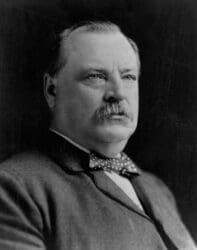
Grover Cleveland (1892)
Library of Congress’s Prints and Photographs division
under the digital ID cph.3a53297.
Since then, organized American labor has seen its ups and downs. Under the administration of President Joe Biden, unions had enjoyed something of a comeback, winning some large victories. President Biden and Vice President Harris had joined the picket lines alongside auto workers–a presidential first. But the election of 2024 reshaped the landscape. A 2024 Labor Department blog celebrating the gains made by unions under President Biden was removed.
In 2026, the Labor Day landscape is very different. The current administration is trying to roll back union protections for federal workers. In March 2025, an executive order “stripped more than a million federal workers of their collective-bargaining rights.” According to one labor historian quoted in the Times, this executive order was, “the biggest act of union-busting in U.S. history.” (Source: New York Times, January 27, 2026)
While the national unemployment rate remains relatively low, many working people are struggling with higher costs and an uncertain future.
As reported in the New York Times,
“Government data released this week showed that consumer prices rose 3.4 percent in July from a year earlier, outpacing a 3.2 percent increase in hourly earnings over the same period. That means that, for the fourth month in a row, Americans’ real wages — how many sandwiches, haircuts and gallons of gas they can buy with an hour’s pay — actually fell.”
Inflation. Sluggish job creation. Sagging wages. Tariff uncertainty. All of it adds up to a bleak picture as we celebrate a day meant to honor America’s working men and women.
Then add Robotics. Autonomous trucks and taxis. And of course, AI. They are all changing the face of the workplace and potential career paths.
But as we rethink work and life, it is a most fitting moment to consider how we have labored and the history of Labor Day. The holiday was born at the end of the nineteenth century, in a time when work was no picnic. As America was moving from farms to factories in the Industrial Age, there was a long, violent, often-deadly struggle for fundamental workers’ rights, a struggle that in many ways was America’s “other civil war.” (For a complete history of Labor Day, read “The Blood and Sweat Behind Labor Day”)
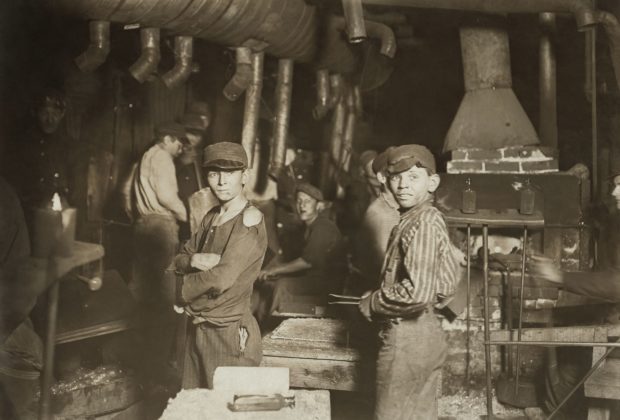
“Glassworks. Midnight. Location: Indiana.” From a series of photographs of child labor at glass and bottle factories in the United States by Lewis W. Hine, for the National Child Labor Committee, New York. Library of Congress
The first American Labor Day is dated to a parade organized by unions in New York City on September 5, 1882, as a celebration of “the strength and spirit of the American worker.” Their goals were simple: decent wages, an eight-hour workday and the right to organize. Among, other things, these labor organizers and working people wanted an end to child labor.
In 1861, Lincoln told Congress:
“Labor is prior to and independent of capital. Capital is only the fruit of labor, and could never have existed if labor had not first existed. Labor is the superior of capital, and deserves much the higher consideration. Capital has its rights, which are as worthy of protection as any other rights. Nor is it denied that there is, and probably always will be, a relation between labor and capital producing mutual benefits. The error is in assuming that the whole labor of community exists within that relation.”
Today, in postindustrial America, Abraham Lincoln’s words ring empty. Labor is far from “superior to capital.” Working people and unions have borne the brunt of the great changes in the globalized and increasingly computerized economy.
But the facts are clear: In the current economic life of America, the loss of union jobs and the resistance to workers organizing is one key reason for the decline of America’s middle class.