By law, Election Day is set on the first Tuesday after the first Monday in November. Of course, there are elections every year. And Americans vote for President every four years.
So, then, what are midterms? Why do they matter? And what does history say about the results?
Here is a quick history and civics lesson.
What are the midterms?
A midterm simply means an election that falls two years after a presidential election. This year the midterm election falls on Tuesday November 3. But early voting has already begun in some states and mail-in ballots will soon be arriving in most states. In other words, the midterms are already underway.
What is at stake this year?
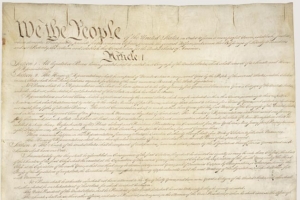
Under the rules dictated by the U.S. Constitution, the entire House of Representatives is up for election every two years. There are 435 voting members in the House, plus six nonvoting members. The current breakdown of the Houses is 218 Republicans, 214 Democrats, 1 independent (Kevin Kiley of CA, who caucuses with the Republicans) and two vacant seats. To win a majority in the House requires 218 seats.
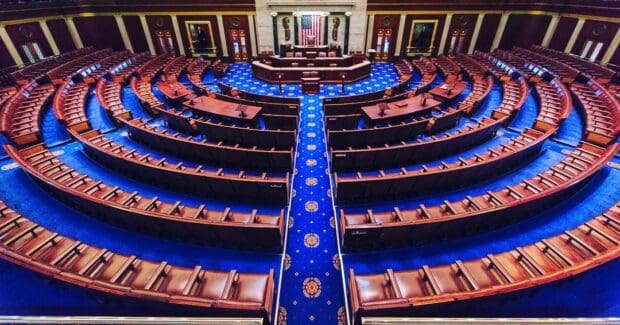
United States House of Representatives chamber at the United States Capitol in Washington, D.C. (Public domain)
The six nonvoting members of the House come from Puerto Rico, Guam, the Northern Marianas, U.S. Virgin Islands, American Samoa, and Washington, D.C. These nonvoting members can take part in House debates and serve on House committees but have no right to vote on the floor of the House.
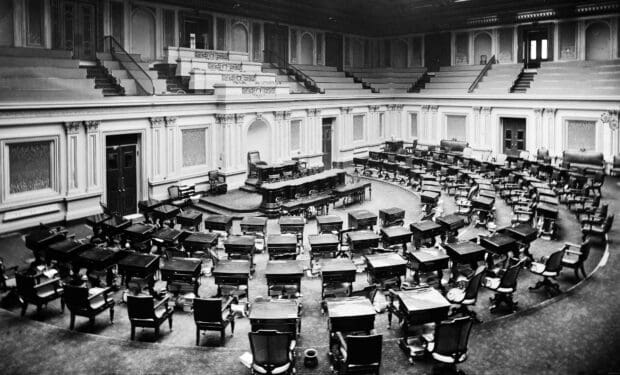
U.S. Senate Chamber, circa 1873 (Public Domain)
There are 100 Senate seats—two for each of the 50 states—and Senators are elected to six-year terms. The Senate operates on a staggered schedule so that one-third of the 100 Senate seats are up for election every two years. The current breakdown of the Senate by party in 2026 is 53 Republicans and 45 Democrats, plus two Independents (Bernie Sanders of Vermont and Angus King of Maine), both of whom caucus with the Democrats.
In this 2026 midterm election, 35 Senate seats are up for election; 33 of the seats are regular elections while two seats are up in special elections in Florida and Ohio. This year, 22 Republican Senate seats are being contested, while the Democrats must defend 13. To win a majority in the Senate (51 seats), the Democrats must win 17 of the 35 contested seats; Republicans need to win 20 of these seats to keep their majority. (In the case of a 50-50 tie, the tiebreaking vote is cast by the Vice President, currently Republican J.D. Vance.)
UPDATE 9/23/2026
In addition to these elections that affect national offices, there are a large number of state and local elections in 2026. There are 18 races for governor this year. In addition, there will be elections to determine state legislators in many states.
“Voters in 46 states will choose 6,139 state legislators on Nov. 3, 2026, deciding over 83% of all legislative seats nationwide. Additionally, voters in Washington, D.C., American Samoa, Guam and the Northern Mariana Islands will elect 157 legislators. Voters will also decide ballot measures that could alter state laws or constitutions on various issues.” (National Conference of State Legislatures)
There will also be local ballot measures in many states, some of which affect voting laws. In other words, this midterm election has great consequences across the nation.
What does history tell us about the midterms?
Historically, there are two broadly-based facts about midterms. First, voter turnout is historically lower in midterm elections than during a presidential contest. Between 50 and 60 percent of eligible voters turnout for presidential elections; the midterms typically see numbers in the 40 percent range. In 2014, turnout fell to about 36 percent.
And the second unavoidable fact is that the sitting president’s party historically loses seats in Congress in the midterms, sometimes enough seats to shift the balance of power in one or both chambers.
There have been exceptions.
Under George W. Bush, the GOP gained seats in both House and Senate in 2002 in the aftermath of 9/11—a first since FDR did so in 1934 during the Great Depression. And in 1998, Democrats gained five House seats and lost none in the Senate during Bill Clinton’s second term, in what is known as the “six-year itch.”
What is the “six-year itch?”
The loss by a president’s party is usually compounded when it is the sixth year of a two-term president’s tenure, also known as the “six-year itch.”
In the sixth year, the president is a lame-duck –the president cannot run for another term. But more significantly, a sense of exhaustion often sets in, and the American people are often ready for a change.
While the current administration was not elected to consecutive terms, the year 2026 counts as this President’s sixth year.
Do midterms really make a difference in the direction of the country?
Losses of seats in Congress almost always matter. Rarely though has there been a “big wave” shift in midterms.
But yes, sometimes the midterms create a significant power transformation. In 1974, a post-Watergate midterm election, Democrats won large majorities in the House and Senate following the resignation of President Richard Nixon in August 1974 and President Ford’s pardon of Nixon on September 8, 1974, a few weeks before the midterm election. The Watergate wave led to a series of major government reforms in the wake of Nixon’s scandals and his resignation from office.
In 1982, large gains by the Democrats in the House led to a major compromise on saving the Social Security system between President Ronald Reagan and House Speaker Tip O’Neill.
In 2006, a “six-year itch” election, President George W. Bush lost both houses of Congress, largely because of the unpopularity of the wars in Afghanistan and Iraq, and the disastrous federal response to Hurricane Katrina in 2005.
In 2010, President Obama suffered—by his own account—a first-term midterm “shellacking” in what was known as the “Tea Party Rebellion.” And Obama lost the Senate in 2014 (another “six-year itch” election) with the result that Republican Majority Leader Mitch McConnell went on to block Obama’s nomination of Merrick Garland to the Supreme Court.
But in 2022, with high inflation in the aftermath of the Covid pandemic, an expected “Red Wave” of Republican victories did not materialize. The Democrats’ losses in the House were minimized while they gained a Senate seat that year. It was widely agreed that voter anger over the Supreme Court decision overturning Roe v. Wade and the January 6, 2021 assault on Congress helped the Democrats stave off a far worse defeat.
What issues matter most in midterms?
Usually, the same issues that matter most in presidential elections, especially pocketbook issues.
But there are always variables.
Scandal—like Watergate— can be a factor in the midterms, as it was after President Nixon’s resignation in 1974 and the pardon of Nixon by President Ford that followed.
On the other hand, the Monica Lewinsky scandal did not hurt Bill Clinton in 1998 when the Democrats gained five House seats and lost none in the Senate.
Being at war doesn’t necessarily add an outpouring of patriotic support to boost the president in power. And sometimes, being at war is a negative. While George W. Bush benefited from a surge in patriotism after 9/11 in the 2002 midterms, he was hurt in 2006 over the increasingly unpopular wars in Afghanistan and Iraq. And after Pearl Harbor in December 1941, FDR lost ground in the 1942 midterms, as the early war effort sputtered.
But “It’s the economy, stupid,” as Bill Clinton’s campaign advisor James Carville famously said in 1992. In the 1982 midterm elections, Ronald Reagan’s GOP lost its House majority during a recession. Voters were unhappy with “Reaganomics,” which promised that tax cuts would boost the economy. The so-called “trickle-down effect” did not impress many Americans.
Closely tied to the state of the economy is presidential popularity—or unpopularity. Voters tend to blame the president for their pocketbook woes. And there are often large losses for the president’s party if the president’s popularity in the polls is under 50 percent.
What does history say about 2026?
It is speculative to be sure. But the bottom line from history is that 2026 could see a “big wave” shift: a bad economy, an unpopular war, a president with dismal approval ratings, and the “six-year itch” all bode well for the Democrats who seek to take control of both houses of Congress. Such a shift would provide the power to challenge the president with legislation, investigations with subpoena power, oversight hearings, and even the possibility of impeachment of the president or his Cabinet officials.
But history is not a crystal ball. There are a lot of wild cards —and voter turnout could prove to be a huge factor.
One thing is certain. The race for the presidency in 2028 begins in earnest after the 2026 election dust settles.
© Copyright 2026 Kenneth C. Davis All rights reserved